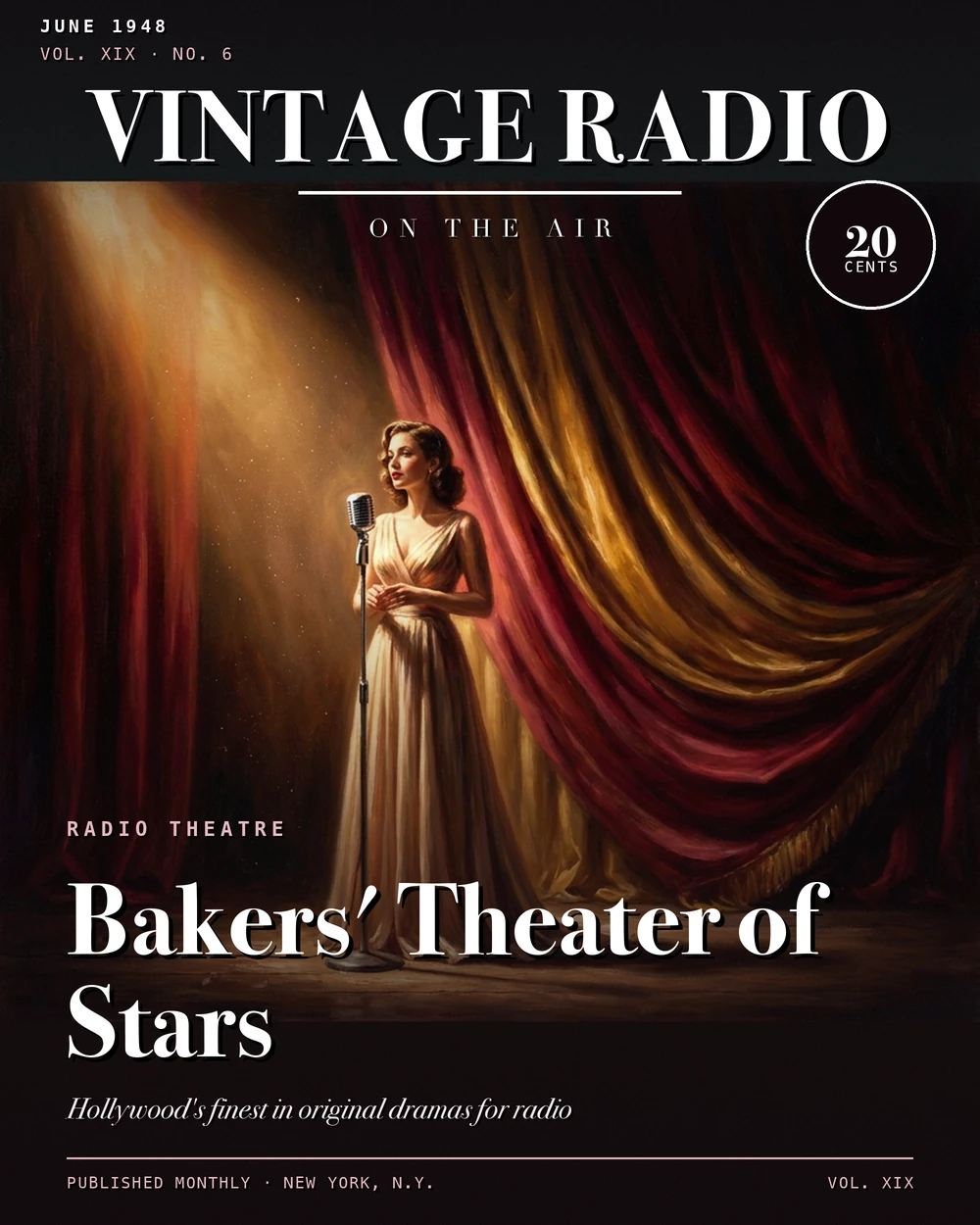
Bakers' Theater of Stars
How It Got on the Air
Bakers' Theater of Stars had an unusual origin. The Bakers of America — an umbrella group representing the American Bakers' Association, The Bakers of America, and Quality Bakers of America — had been sponsoring a radio drama called Hollywood Star Playhouse. When the show moved to CBS, NBC held the rights to the Hollywood Star Playhouse name, so the sponsor simply renamed it. Bakers' Theater of Stars launched on March 1, 1953 on CBS Sunday nights as a half-hour anthology, conceived from the start as a 13-week run.
The format was straightforward. Each week, a roughly 25-minute original radio play featured a top Hollywood name in the lead. That left a minute or two for the Bakers of America's home economist, Miss Helen Reed, to share an easy recipe and put in a word for the organization. After her segment, the host chatted briefly with the guest star and previewed the following week's play.
The Talent Behind It
The production team had real credentials. Norm MacDonald produced and directed, and John Meston — who would go on to shape Gunsmoke — supervised the scripts. Les Crutchfield and Antony Ellis were among the writers, and Wilbur Hatch's name is associated with the show's music.
The guest roster was the headline attraction. Joan Fontaine, Joseph Cotten, Vincent Price, Dana Andrews, Robert Taylor, and Ronald Reagan all appeared. "The Mail Order Bride" featured Robert Taylor alongside Parley Baer, John Dehner, Harry Bartell, and Lawrence Dobkin — a supporting cast with deep radio experience. The scripts were original radio plays rather than adaptations of novels or stage works, which put the weight squarely on writing and performance rather than source material.
What Survives
The series ran only until May 10, 1953 — 13 scripts in total, exactly as planned. Known titles include "The New Man," "The Mango Tree," "The Impressario," "The Mail Order Bride," and "The Remarkable Talent of Egbert Haw." Of the 13 scripts produced, only five survive. It was a short run by any measure, and those surviving episodes are the primary record of what the show sounded like — original dramas built around recognizable Hollywood voices, produced with sound effects and music, and packaged inside a simple, sponsor-friendly half-hour.